
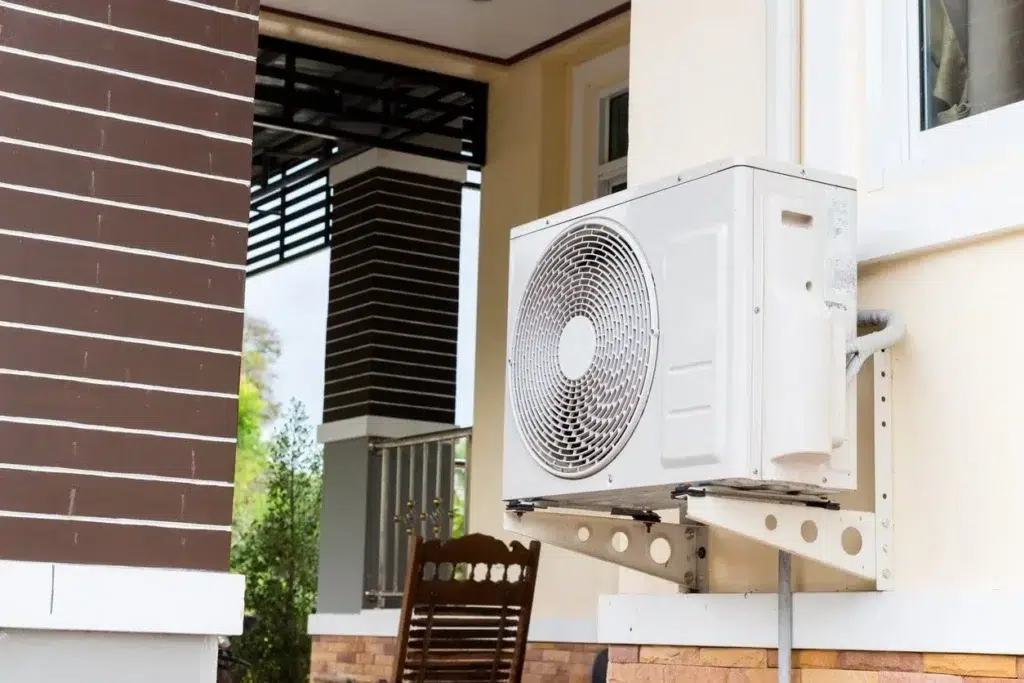
If your heat pump runs all the time in Portland, it may mean that there is an underlying problem that needs to be diagnosed and repaired. However, there are also instances where a heat pump running constantly isn’t cause for concern. From heat pump icing to frequent repair issues, we’ll look at common heat pump problems in Portland.
First, the Good News: When Constant Running Is Actually Normal in Portland
So, is it normal for a heat pump to run all day? In some cases, it might be.
During our recent cold snap, temperatures dropped to the mid-20s°F. At this temperature, air-source heat pumps can become significantly less efficient. Many standard units have to switch on their backup resistance heat strips to keep up with the cold weather. When this happens, you’ll typically see the “AUX” or “Emergency Heat” mode activated.
A heat pump’s efficiency in Portland winters can struggle, so there are situations where constant running is normal. If you don’t notice any other symptoms and the temperature is quite low, non-stop operation may not be a cause for concern.
How Heat Pumps Work Differently Than Furnaces
Heat pumps are fundamentally different from furnaces because they transfer heat instead of creating it. Like air conditioners, heat pumps use refrigerants to absorb and move heat.
What the ‘Balance Point’ Means for Portland Heat Pumps
In HVAC terms, the balance point is the point where a building’s heat loss equals its internal heat gains. Basically, the heat pump reaches a tipping point where its ability to absorb heat from the air exactly matches how much heat is lost. In Portland, high humidity levels, a lack of solar heat, and consistently cold temperatures mean heat pumps are running constantly during the winter. This pushes a heat pump’s balance point temperature in Portland, making it harder to keep up.
When Constant Running Becomes a Red Flag
When a heat pump won’t stop running in Portland, it isn’t necessarily a problem if the weather is unusually frigid. However, you may need professional repairs if you notice the following symptoms:
Your Home Still Feels Cold Despite Hours of Running
When your home doesn’t warm up, it indicates your heat pump isn’t keeping up. This can stem from multiple problems, so you should schedule a professional heat pump repair in Portland, Oregon, to get the issue addressed.
Unusual Sounds Alongside the Constant Operation
If your heat pump won’t stop running in Portland, there may be other signs of an underlying problem. The outdoor unit of a well-maintained heat pump should produce a low, steady hum. Additionally, the vents of a functional heat pump should create gentle airflow.
If the heat pump is straining, you’ll hear intermittent clicking or labored humming. A loose capacitor bracket can also cause soft rattling.
Ice Buildup Beyond the Normal Defrost Cycle
When the weather is cold, moisture can gather and freeze on the outdoor coils. Your normal defrost cycle should melt the ice completely. If it doesn’t, there is something else wrong with your heat pump.
Your Energy Bills Have Spiked Without a Change in Usage
Anytime your energy bills spike without a clear reason, it indicates that there may be an issue with your HVAC system.
5 Common Causes of a Heat Pump That Won’t Cycle Off
There are a few common reasons why you might have a heat pump constantly running but not heating.
1. Portland Cold Snaps Pushing the System Past Its Efficiency Threshold
Sometimes, Portland’s cold snaps are so extreme that your heat pump just can’t keep up. As long as the heat pump normally doesn’t have a problem, temporary issues keeping up might not be a reason to be concerned.
2. A Dirty or Blocked Air Filter
When an air filter is clogged, it prevents airflow and forces your heat pump to work harder to keep up.
3. Refrigerant Loss Reducing Heating Capacity
If there is a leak, refrigerant can escape from your system. Without enough refrigerant, the heat pump has to work harder to absorb and transfer heat.
4. An Undersized System for Your Home’s Square Footage
In Portland’s Sellwood or Ladd’s Addition, you’ll often find older homes that have accessory dwelling units (ADUs). Because of this, it’s common to see homes that have grown in size but still use a 2-ton system. If your home’s heat pump is undersized for your square footage, it will have to run longer to reach the same temperature.
5. A Failing Capacitor or Reversing Valve
A faulty reversing valve can cause the heat pump to get stuck in one mode. Meanwhile, a failing capacitor makes the compressor work harder to compensate and can lead to longer run times.
What You Can Check Before Calling a Technician
To troubleshoot, start by performing your routine HVAC maintenance.
- Replace or clean the HVAC filter.
- Check your thermostat settings to make sure it is set to the appropriate mode and temperature range.
- Clean around your outside unit. There should be 2 to 3 feet of clearance from debris, snow, and plant matter.
- Look for damaged ductwork in easy-to-reach places.
- Verify the air temperature coming from the vents.
What a Heat Pump Diagnostic Service Call Looks Like
A typical diagnostic service call takes us about 60 to 90 minutes to complete. During the visit, the technician will start by attaching the refrigerant manifold gauge set. This allows us to test the suction and discharge pressure. Then, a multimeter can be used to test your capacitor’s microfarad ratings. We’ll also perform an airflow measurement at your supply registers.
By completing all these tests, we can quickly determine the underlying problem. Then, we can recommend the best heat pump maintenance or repairs for your needs.
How Routine Maintenance Prevents This Problem
Through preventative maintenance, you can get your entire system cleaned and inspected before the first cold snap arrives. Proper maintenance helps to prevent problems from occurring. It also allows you to spot and repair issues before they escalate. With routine tune-ups, you can also improve the efficiency of your HVAC system so that it achieves the same temperature with less effort.
Frequently Asked Questions
Is it OK for a heat pump to run all night?
In extremely cold temperatures, this may be completely normal. If the weather is moderate, your heat pump shouldn’t have to run all night. Schedule an inspection if you think there may be something wrong with your unit.
At what temperature does a heat pump stop being effective?
It depends on the unit. Traditional heat pumps typically work well to about 32°F before they start losing their efficiency. With cold-rated heat pumps, the unit can work effectively as low as -15°F to -22°F.
Why does my heat pump run but blow cold air?
If your heat pump is running but blowing cold air, it may be stuck in fan mode. It may also do this briefly if it is using defrost mode. Check your thermostat and see if fan mode or defrost mode is in effect. If not, there is likely an underlying issue that needs to be repaired by a professional HVAC technician.
Schedule Your Next Heat Pump Tune-Up
Is your heat pump running constantly? You’re not alone. When a heat pump runs all the time in Portland, it often indicates that there is an underlying maintenance or repair issue that needs to be addressed. If your heat pump won’t stop running, don’t wait to get help and get your heat pump service.
Schedule your next heat pump service with Central Air. Since 2001, we’ve been Portland’s trusted HVAC team. Local residents turn to us because of our NATE-certified technicians, same-day appointments, and extensive expertise.