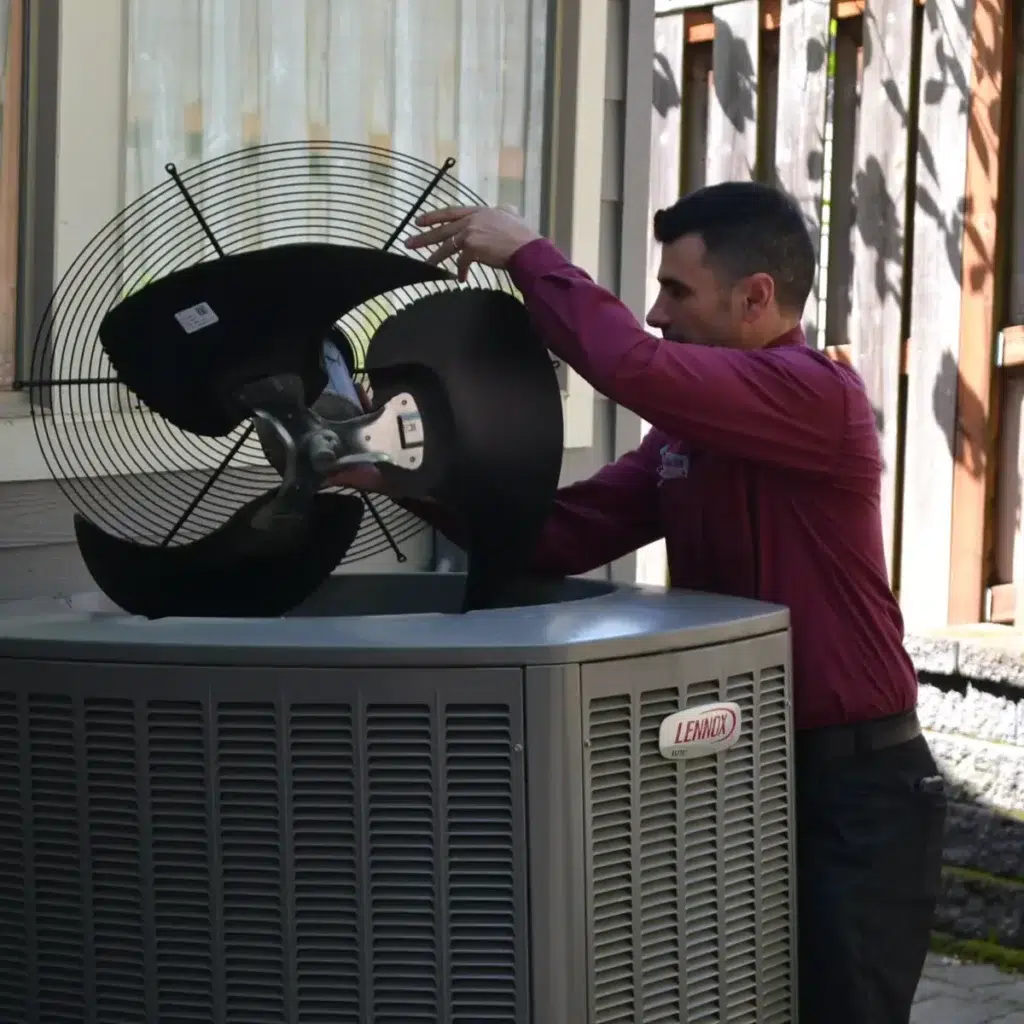
Your condenser fan is an essential part of your heating, ventilation, and air conditioning (HVAC) system. The fan motor turns the fan so that outdoor air can be pulled across the coils, allowing the coils to release heat. If the motor isn’t working, it can cause your compressor to overheat. Worse still, a malfunctioning fan motor can impact your indoor comfort and cooling performance.
Through the right condenser fan motor troubleshooting, you can determine the cause of your current problem and learn when professional help is necessary.
Signs the Condenser Fan Motor Is the Real Issue
Portland retrofits, older air conditioners, and smoke-season damage can make fan motor damage show up earlier than it normally would. If you notice the following signs, it’s possible your condenser fan motor is not working properly.
- The condenser fan motor is hot and not running.
- You notice a loud humming, grinding, and rattling noise.
- The system shuts down frequently.
- You smell a burning odor.
- The fan spins slowly or not at all.
- The compressor keeps overheating.
Most Common Reasons the Outdoor Fan Stops Working
So, what causes a condenser fan motor to fail? If you’re having problems with your condenser fan motor for your AC unit, there are a few common reasons why that could be happening.
Failed Run Capacitor
The capacitor is responsible for helping your outdoor unit to start up. If it isn’t functioning properly, your unit won’t start, or it will run poorly.
Worn Fan Motor
Over time, the fan motor can wear out and require replacement. If you’ve had your system for a few years, that could be the culprit.
Bad Contactor or Loose Electrical Connection
A failed contactor or loose electrical connection can prevent the outdoor unit or fan motor from receiving power.
Dirty Condenser Coil or Blocked Airflow
When the condenser coil is dirty or airflow is blocked, it prevents the transfer of heat and creates added strain on the compressor. Early on, you’ll likely notice problems with your cooling performance. If the strain continues, it can eventually trigger an automatic safety shutdown.
Control or Thermostat Issue
If the control or thermostat isn’t working appropriately, your unit won’t turn on. This is another issue that becomes more likely to happen the longer you’ve had your system.
Safe Checks To Make Before Calling
Before you call for professional repairs, there are a few things you can check on your own.
Confirm the Thermostat Has a Cooling Problem
First, check your thermostat to see if it is set to “cool” mode. Change the temperature to several degrees below the current indoor temperature to see if the unit turns on. If it doesn’t, your thermostat may be the issue.
Check the Breaker Once
You can reset a tripped breaker once if it has flipped. However, repeated trips are an indication of an underlying electrical problem that must be addressed by a professional.
Make Sure the Disconnect Is Fully Seated
If the disconnect is not properly seated, it can cause arcing and equipment failure. Confirm that the disconnect is fully seated. If it isn’t, call an HVAC technician for repairs.
Clear Obvious Debris Around the Condenser
Debris around the condenser unit can negatively impact airflow, so clean a 2 to 3-foot space around the outdoor unit.
Replace a Badly Clogged Air Filter
Check filters monthly and replace them every 30 to 90 days, or according to the filter and system manufacturer’s guidance.
When To Shut the System Off and Call for Help
You should immediately shut off your AC and call us at (971) 435-7303 if you notice any of the following:
- Burning odors.
- Fan not spinning.
- Frequently tripped breakers.
- Loud grinding or rattling noises.
- Iced-up coils.
What Our Team Checks During a Diagnosis
When our HVAC team visits your home, we’ll use the following checklist as part of our condenser fan motor troubleshooting.
- Check the thermostat to make sure it is signaling your AC to start.
- Turn off the power at the disconnect box and breaker for safety.
- Test the bearings by spinning the blade.
- Check the blade condition and remove any debris.
- After discharging the capacitor, use a multimeter to test its capacitance and verify it is within its rating.
- Disconnect the fan motor wiring to test the resistance.
- Use a multimeter to check for proper equipment grounding and to test for shorts to ground.
- Verify the condition of the condenser coils.
- Use a clamp meter to check the motor amp draw.
Fan Motor Repair vs. AC Replacement
As a homeowner, it can be hard to tell when you need a basic fan motor repair or a complete AC replacement. While a repair will normally cost less, you may want to consider a full AC replacement if your unit is reaching the end of its normal lifespan or requires frequent repairs. If other expensive repairs are also necessary, a new AC may be your best option.
FAQs
Can a bad capacitor make it look like the fan motor failed?
Yes, it can. Capacitors help the motor start and run properly, so a failing capacitor can make it appear like the fan motor isn’t working properly.
Is it safe to keep running the AC if the outside fan is not spinning?
No, it isn’t. Continuing to run an AC in this condition can end up causing major damage to your unit. Never try to push the fan yourself. For safety reasons, leave this type of troubleshooting to the experts.
Why does this problem seem to show up during the first hot week?
During heatwaves, air conditioners are used longer and handle heavier loads. This type of intense usage exposes any underlying weaknesses. Pre-season inspections and maintenance can help you prevent and remedy these issues before peak heat arrives.
Could this be something other than the fan motor?
Yes, it can. These symptoms can be related to your capacitor, condenser, refrigerant levels, and other factors. To ensure your HVAC system is diagnosed properly, reach out for professional AC repairs.
Schedule AC Repair in Portland
If you’re struggling with condenser fan motor troubleshooting, Central Air Heating, Cooling & Plumbing can help. Call us at (971) 435-7303. Our team is available 24/7 for emergency repairs and maintenance issues. Plus, our zero-risk repairs mean your AC repairs are guaranteed to last for three years.
Learn more about how we can help by booking a diagnostic evaluation today.